Essay Examines How Elliott Smith’s Music Became a Shared Language of Grief and Devotion
A Literary Hub essay looks closely at Elliott Smith’s Los Angeles Fonda Theatre performance and uses it to explore the singer-songwriter’s legacy, his fragile recovery, and the intensely collaborative culture built by fans after his death. The piece argues that Smith’s artistry and empathy remain inseparable in the way listeners remember him and keep his work circulating online.
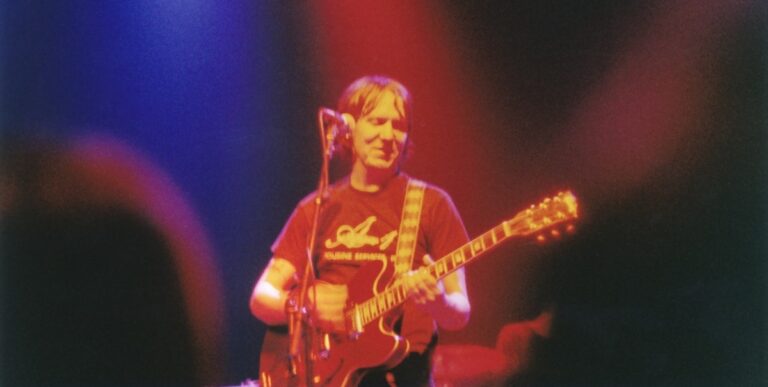
An essay published by Literary Hub uses Elliott Smith’s January 2003 Fonda Theatre performance in Los Angeles as the center of a larger reflection on how his music is remembered, discussed, and loved. The piece revisits one of the last videos of Smith and treats it not only as a concert document but also as a revealing snapshot of a career defined by vulnerability, precision, and emotional reach.
The performance itself is presented as unsettled from the start. Smith appears slumped over his guitar in a metal chair, sounding tired and unsteady before gradually settling into the set. Midway through, after “Pretty (Ugly Before),” he reacts to a heckle, briefly bristling before softening and apologizing once he realizes he may have misheard the comment. The essay dwells on that exchange as evidence of Smith’s mix of defensiveness and sensitivity, qualities that shaped both his music and his stage presence.
From there, the article turns to “Plainclothes Man,” framing it as a song about addiction and, more broadly, about change and need. Written in the mid-1990s during Smith’s transition out of his band and into the solo career that made him famous, the song is used to illustrate the development of his mature songwriting voice: economical, sly, and deeply controlled even when the subject matter is painful. The essay also notes how his singing had changed by then, moving from the rawer register of earlier recordings to a softer, more assured delivery.
That shift becomes part of a larger argument about Smith’s relationship to sadness. The piece suggests that he wrote sad songs without wanting to make listeners feel cornered by them, and that his work often carried an unusual, almost shy empathy. The Los Angeles concert is described as marking the start of a fragile comeback tour and a period of promising sobriety, though the performance also shows how closely recovery and instability remained intertwined in his public image.
The essay situates the Fonda Theatre video as one of the most discussed Smith recordings precisely because it holds so many contradictions at once. It is read as both a document of recovery and a reminder of how his death in October 2003 altered the way audiences hear his music. The performance is also presented as a testament to his craft: a songwriter able to turn private struggle into songs that feel intimate without becoming sentimental.
A substantial portion of the piece focuses on what has happened to Smith’s legacy online. It describes a collective fan effort built through YouTube accounts, old fan sites, oral-history blogs, chord-and-tab pages, bootleg exchanges, and discussions of unreleased material. These spaces have become informal archives where listeners debate his performances, parse his lyrics, and continue to speculate about his death while also sharing stories of how his songs helped them through depression, addiction, loneliness, and grief.
The essay argues that Smith remains deeply loved even if he is not especially well understood by the wider public. It suggests that part of the ongoing appeal lies in the imperfect, degraded quality of the available recordings, which make his performances feel fragile and immediate. For fans, the material remnants of his career — concert videos, tapes, comments, and fragments of memory — have become the means by which his art continues to be preserved and reinterpreted.