A Los Angeles Concert Video Captures Elliott Smith’s Fragile Return — and the Devotion It Still Inspires
A late concert recording from Los Angeles has become one of the defining images of Elliott Smith’s career: uneven, intimate, and full of tension between recovery and collapse. More than two decades after his death, fans continue to treat that performance as part of a larger shared effort to preserve and interpret his work.
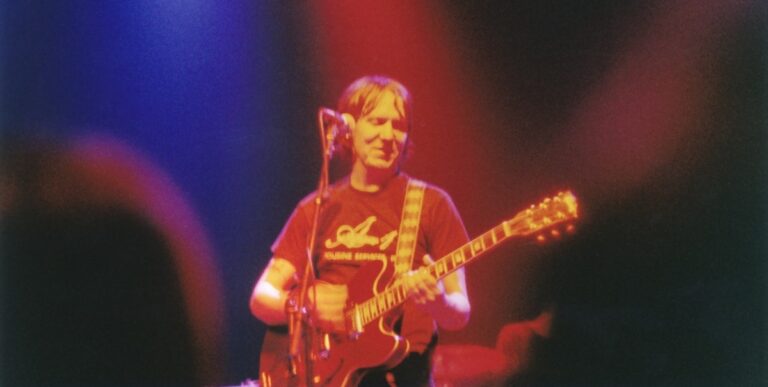
One of the most widely circulated videos of Elliott Smith shows him at the Fonda Theatre in Los Angeles, seated in a metal chair, slouched slightly over his guitar and singing through a set that never feels entirely settled. The performance opens shakily, with a voice that sounds worn and unfocused, but it gradually becomes one of the clearest documents of his public persona: vulnerable, alert, funny, apologetic, and deeply committed to the songs even as he seems to be testing their emotional limits.
The recording captures a tense exchange in the middle of the show, when someone in the audience shouts at him and he stops to parse the words. He repeats the phrase back, asks for clarification, and responds with irritation before softening almost immediately. The moment is revealing not only because of the heckling itself, but because of the way Smith moves through anger into self-correction, as if he is constantly adjusting how much of himself he is willing to expose. That quality — the simultaneous defensiveness and openness — has long been central to how listeners remember him.
The song that follows, “Plainclothes Man,” sharpens that impression. Written in the mid-1990s, during the transition out of his band and into the solo career that would define him, it belongs to a period when Smith’s writing and singing were changing in tandem. His early pubescent croak had given way to a lower, steadier voice, one that could sound both intimate and authoritative. The song’s subject may be addiction, probably heroin, but its emotional force comes from something broader: change, need, and the uneasy possibility of transformation.
That Los Angeles concert is now understood as the beginning of a fragile comeback tour and a promising period of sobriety. The performance is not presented as triumphalist or tidy. Smith’s voice grows stronger as the night continues, but it also breaks and wavers under the pressure of feeling. He seems to be singing to, and against, the crowd at once. When he finishes the song, he says it is too sad to end on, then declines to close the show with it. Even there, the refusal feels characteristic: he had a gift for writing songs steeped in darkness without wanting to leave listeners trapped inside it.
The significance of the recording has only grown in the years since it was made in January 2003, months before his death in late October. In the present, it functions as both a performance document and a contested artifact, especially for listeners who read it as evidence about his recovery. But the video’s lasting value is larger than any single interpretation. It is a concentrated glimpse of his artistry and of the empathy that ran through it — an empathy that felt shy, excessive, and self-endangering all at once.
That same quality helps explain why Smith remains, even now, more deeply loved than broadly understood. His legacy has become a collective project carried forward by fans who archive, annotate, and trade recordings; preserve old web pages; build sites for guitar tabs and chord help; and write long reflections on lyrics, performances, and the circumstances of his death. Around his videos, comment threads fill with memories, gratitude, arguments about whether he sounds tired or unwell, and stories about what his songs meant during periods of depression, addiction, grief, or loneliness.
The online world around Smith also reflects the era in which much of his work was documented: late enough that video cameras and digital sharing preserved a lot, early enough that many of those materials remain sparse, degraded, and imperfect. Some recordings have turned to fuzz; others are rough and overexposed; some are clear enough to make his small gestures feel immediate, as if he were sitting beside the viewer. That uneven archive, with all its technical limits, has become part of the emotional power of his afterlife. It mirrors the fragility that listeners hear in the songs themselves — and helps explain why, so many years later, Elliott Smith still inspires the kind of devotion that is at once intensely personal and unmistakably collective.